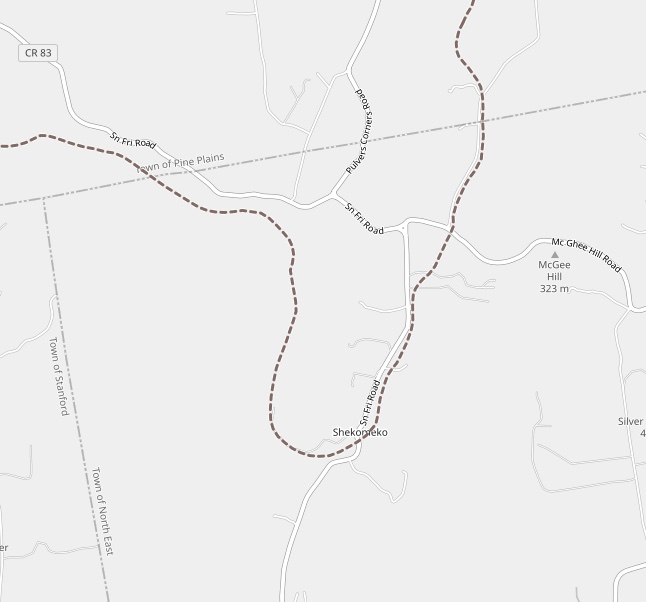
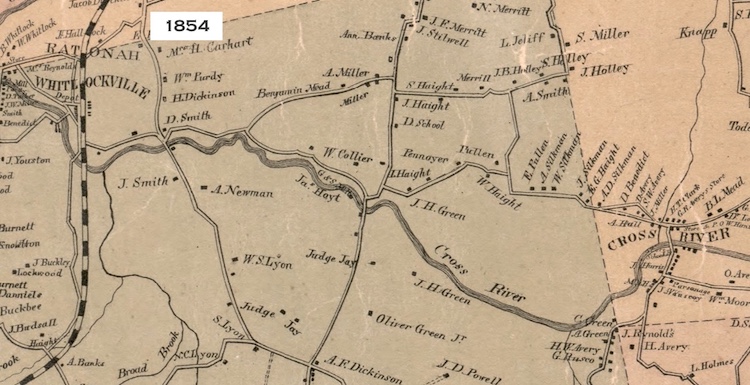
Shekomeko was a small historic hamlet in eastern Dutchess County, New York. Originally a village of Mahican Native Americans, the name Shekomeko was derived from their Algonquian language:
she, -che (from mishe or k'che), 'great,' and comaco, 'house,' or 'enclosed place'—'the great lodge,', or 'the great village.'"
(click on any graphic to enlarge)
Native Americans and the Moravian Mission
The village has a fascinating history. It was Moravian mission and in the summer 1742,
Shekomeko was established as the first native Christian congregation in America. The increasing Moravian influence and their success with the Native Americans led to resentment by European settlers in the area. False rumors of atrocities were spread and the authorities were petitioned to intervene. A law was enacted on September 21, 1744 forbidding anyone from residing with Indians in order to Christianize them.
 |
| Shekomeko village and Moravian mission, 1745 |
By 1746, area settlers petitioned the governor to issue to them a warrant authorizing the killing of Shekomeko Indians. Shortly thereafter the mission was abandoned and the ten remaining families--a mere 44 persons where all that remained of the original 8,000 member tribe 100 years before--sought refuge in nearby Connecticut, while others traveled to Pennsylvania to be closer to the established Moravian settlements there.
A Railroad is Built
Construction on the
Dutchess and Columbia Railroad began in 1868, and by 1869 the line reached north to Pine Plains. Construction then continued eastward through
Shekomeko reaching
Millerton in 1871. In 1877 the railroad was reorganized as the
Newburgh, Dutchess and Connecticut Railroad (ND&C). In 1905 the
New York, New Haven and Hartford Railroad acquired the ND&C and in 1907 merged it into the
Central New England Railway.
Click any image to enlarge it
Sadly in 1925 the railroad line from
Shekomeko east to
Millerton was abandoned. Then in 1935, the line from
Shekomeko west to
Pine Plains was abandoned and by 1938, the entire railroad line was abandoned.
Traces of the roadbed can still be found in places.
Today
There's little left of the village now as this
google aerial illustrates but there is a monument dedicated to the Moravian Christian Mission that was dedicated by the NY Moravian Historical Society in Oct 5, 1859.