Showing posts with label music. Show all posts

Monday, January 18, 2021

Two fabulous interactive data visualizations

A couple of really well done interactive data visualizations...

1 - Galaxy of Covers

How can music and a love of interplanetary ideas mix together to make a data visualization? With this lovely interactive example of a data analysis about famous song covers. Each song is a planet and its covers are satellites orbiting around it. Each song planet can be clicked on to visualize its own specific data. 

Songs...

  • Walk On By
  • All Along The Watchtower
  • Hallelujah
  • With A Little Help From My Friends
  • etc.

Scroll down and interact - amazing

Go to Interactive Visual >


2- 200 Years of Immigration to the U.S

This is beautiful! Hover over any color at any point, and see the exact number of immigrants who became residents from that country in a specific decade. 

Wednesday, January 13, 2021

Rock Band Timelines

Wikipedia is always a great resource for info. From obscure history details to well written summations of art, literature and music its no wonder Google Searches always turn up a Wikipedia page first!

The visual format of the revolving membership in rock bands is a great example of well done data visualization. Below are a few from the collection. Click any graphic to see its enlargement

Allman Brothers

Eagles

FleetwoodMac

Genesis

Frank Zappa and the Mothers of Invention

Pink Floyd

Rufus

The Band

Traffic

v
x

Friday, July 28, 2017

Graphing Jazz

Is Jazz Dead?

Even though Miles Davis’ 1959 Columbia recording “Kind of Blue” is still the biggest selling jazz album of all time with more than 20 million sold to date— Sony’s Columbia label, the former home of Miles Davis’ recordings, no longer signs jazz .

“With the advent of the celebrity-as-musician trend in the 21st century, artistry is quickly going by the wayside. Many of today’s popular artists can’t sing or play an instrument. They are all image and attitude. Jazz, always touted as America’s one true art form, is struggling to survive. The major record labels shy away from niche markets, and promotion and marketing money goes with the youth demographic, which is generally under-educated about the art of music. This presents a cultural and ethical problem.”
- by Sal Polcino

Below are a few charts on and graphs on the great and sadly highly misunderstood art form.

Sales

Comparing Music 


Article:
Types of Jazz Listeners

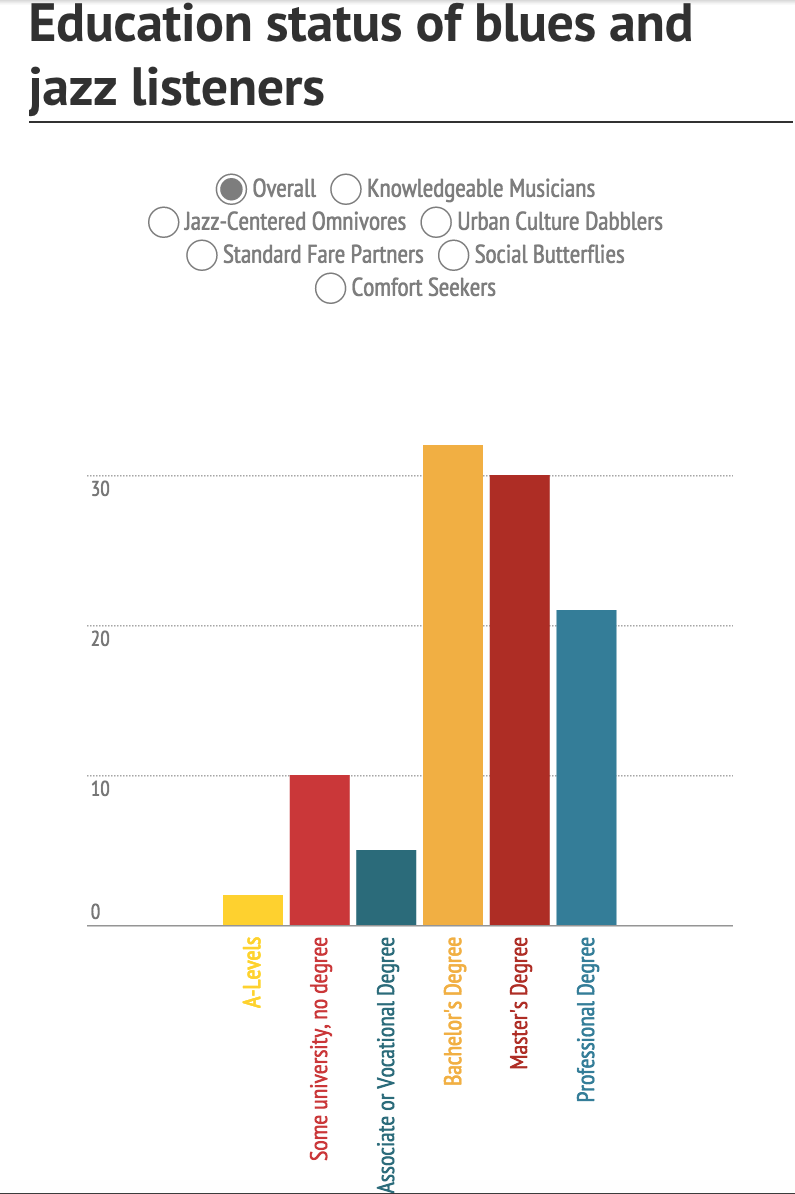
Education Status of of Jazz Listeners

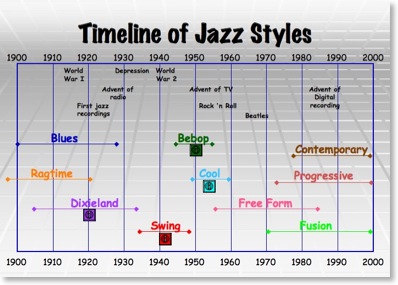
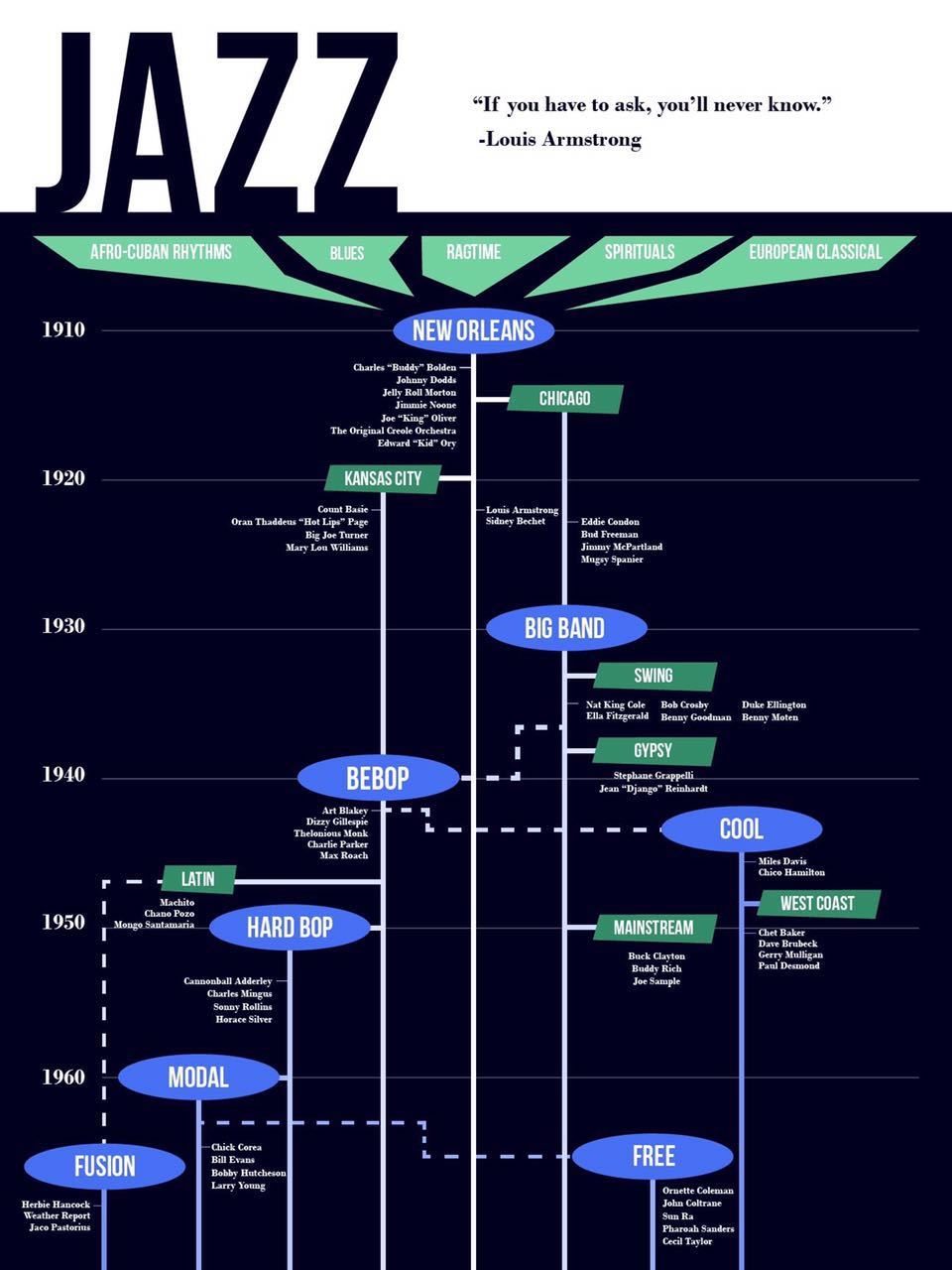
History (Timelines)

Longevity?

Article:
The Future of Jazz in America


Wednesday, January 4, 2017

Musician's Timelines (Famous Groups)

Kinda cool... (Click any image to enlarge)

Chicago

Chicago is an American rock band formed in 1967 in Chicago, Illinois. The self-described "rock and roll band with horns" began as a politically charged, sometimes experimental, rock band. The group had a steady stream of hits throughout the 1970s and 1980s. Second only to The Beach Boys in Billboard singles and albums chart success among American bands, Chicago is one of the longest-running and most successful rock groups, and one of the world's best-selling groups of all time, having sold more than 100 million records.
Chicago - Personnel Changes Timeline
Chicago (Wikipedia)

Beatles

The Beatles were an English rock band, formed in Liverpool in 1960. With members John Lennon, Paul McCartney, George Harrison and Ringo Starr, they became widely regarded as the foremost and most influential act of the rock era.

According to the RIAA, the Beatles are the best-selling music artists in the United States, with 178 million certified units. They have had more number-one albums on the British charts and sold more singles in the UK than any other act.

As the group's music grew in sophistication, led by primary songwriters Lennon and McCartney, they came to be perceived as an embodiment of the ideals shared by the counterculture of the 1960s.
The Beatles - Personnel Changes Timeline
The Beatles (Wikipedia)

Eagles

The Eagles debut album was released on June 1, 1972, It was a breakthrough success, yielding three Top 40 singles. Their second album, Desperado, took Old West outlaws for its theme, drawing comparisons between their lifestyles and modern rock stars. This album was the first to showcase the group's penchant for conceptual songwriting.

Joe Walsh joined the band in 1975. There was some initial concern as to Walsh's ability to fit in with the band, as he was considered too "wild" for the Eagles, especially by Henley

In early 1976, the band released their first compilation album, Their Greatest Hits (1971–1975). The album became the highest-selling album of the 20th century in the United States, and has since sold 29 million copies in the U.S. and 42 million copies worldwide. It stayed the biggest seller of all time until it was taken over by Michael Jackson's Thriller following the artist's death in 2009. The album cemented the group's status as the most successful American band of the decade. More info on the Wikipedia site.
The Eagles - Personnel Changes Timeline
The Eagles (Wikipedia)

and finally...

Google Music Timeline 

Explore the history of Pop and Punk, Jazz, and Folk - this is really cool! "This is an Interactive visualization to show “which music has stood the test of time”, and how genres and artists have risen and fallen in popularity. "
The Music Timeline uses aggregated data from Google Play Music...
About the Music Timeline (Google Research Blog)
- Read the Blog for an in-depth explanation.

- Click on the actual timeline to explore different musical genres


Friday, October 21, 2016

Music Mechanics Series - Tracker Organ

The organ is a fascinating mechanical contraption. Along with the clock, it was considered one of the most complex human-made mechanical creations before the Industrial Revolution. The instrument traces its history as far back as at least the 3rd Century B.C. and uses wind moving through pipes to produce sounds.

Since the 16th century, pipe organs have used various materials for pipes, which can vary widely in timbre and volume. The pipes are divided into ranks and controlled by the use of hand stops and combination pistons.

The Mechanics
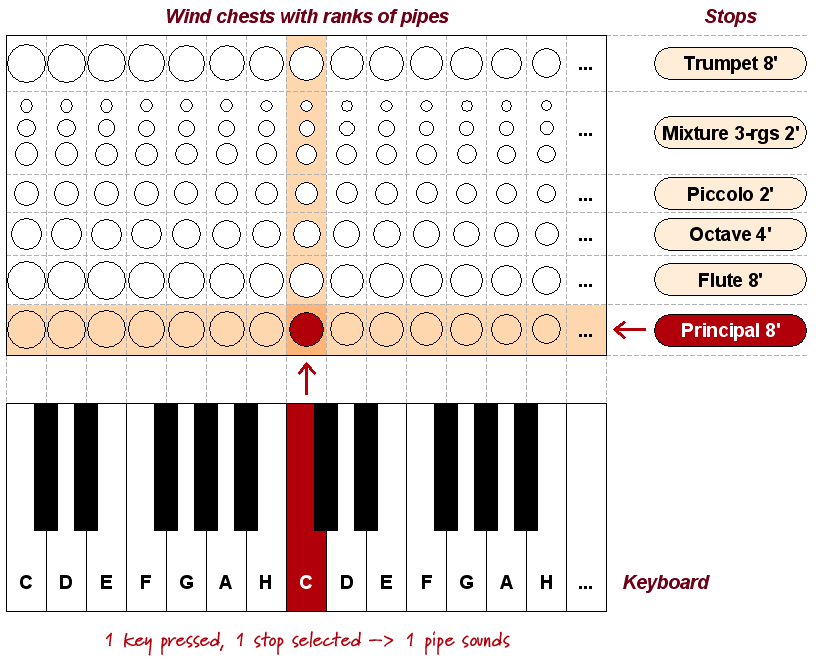
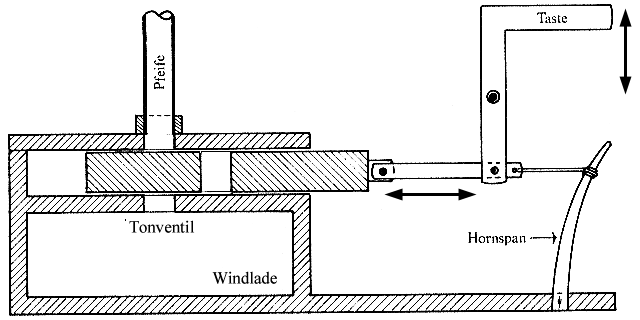
Below are an assortment of diagrams (one is even animated), all created to help illustrate the mechanics of how an organ works...


Tracker Organ

A Tracker organ uses tracker action -  a term to indicate a mechanical linkage between keys or pedals pressed by the organist and the valve that allows air to flow into pipe(s) of the corresponding note. This is in contrast to (1) direct electric action which connect the key to the valve through an electrical link or (2) electro-pneumatic action  which connect the key to an electrically assisted pneumatic system respectively, or (3) tubular-pneumatic action which utilizes a change of pressure within lead tubing which connects the key to the valve pneumatic.


Did You Know?

  • The loudest organ stop in the world is the Grand Ophicleide located in the Right Pedal division of the Boardwalk Hall Auditorium Organ (see link below). It is described as having "a pure trumpet note of ear-splitting volume, more than six times the volume of the loudest locomotive whistle." The Grand Ophicleide produces up to 130 decibels at a distance of 1 meter. A former organ curator warned the stagehands when the Grand Ophicleide was going to be used, because of the volume.
  • The air needed for the pipes to speak (usually called the "wind" by organ builders) used to be produced by people treading on or pumping up down on a lever to force wind into huge bellows on a side chamber of the organ. Today a blower worked by a huge electric motor has taken over this job, but the principle remains the same. Today a blower worked by a huge electric motor has taken over this job, but the principle remains the same.


Friday, July 8, 2016

Music Mechanics Series - Mellotron

Mellotron 

The Mellotron was originally developed and built in Birmingham, England, in 1963. The original models were designed to be used in the home, and contained a variety of sounds, including automatic accompaniments! Adopted by the Moody Blues, Genesis and King Crimson, it became a notable instrument in progressive rock. Production of the Mellotron ceased in 1986.
A diagram illustrating the internal operations of a Mellotron

How it Worked

Pressing a key (1), caused two screws (2) to connect a pressure pad (3) with the tape head (5), and the pinch wheel (4) with the continuously rotating capstan (6). Tape was pulled by the capstan at a gradual speed controlled by a tension spring (8–10) and stored temporarily in a storage bin (7) until the key was released.

Interesting Facts:

  • Noted cellist Reginald Kirby refused to downtune his cello to cover the lower range of the Mellotron, and so the bottom notes are actually performed on a double bass.
  • Pressing a key harder allows the head to come into contact under greater pressure, so to an extent,  the Mellotron responds to aftertouch.
  • Among the early Mellotron owners were Princess Margaret, Peter Sellers, King Hussein of Jordan and Scientology founder L. Ron Hubbard!
  • The Skellotron (2005) was a Mellotron in a transparent glass case. Only one was made!

Article > 


Friday, July 24, 2015

Interactive "Music Infographics" from the Google Creative Lab

Alexander Chen - Google Creative Lab

This work is outstanding!!

Conductor turns the New York subway system into 
an interactive string instrument.


Les Paul Google Doodle 

- A tribute to Les Paul.

Pianophase.com -
A performance and visualization of the first section from 
Steve Reich's 1967 piece Piano Phase.

Visit:

http://www.chenalexander.com


Sunday, April 12, 2015

Monday, November 24, 2014

Hieronymus Bosch - Butt Music!

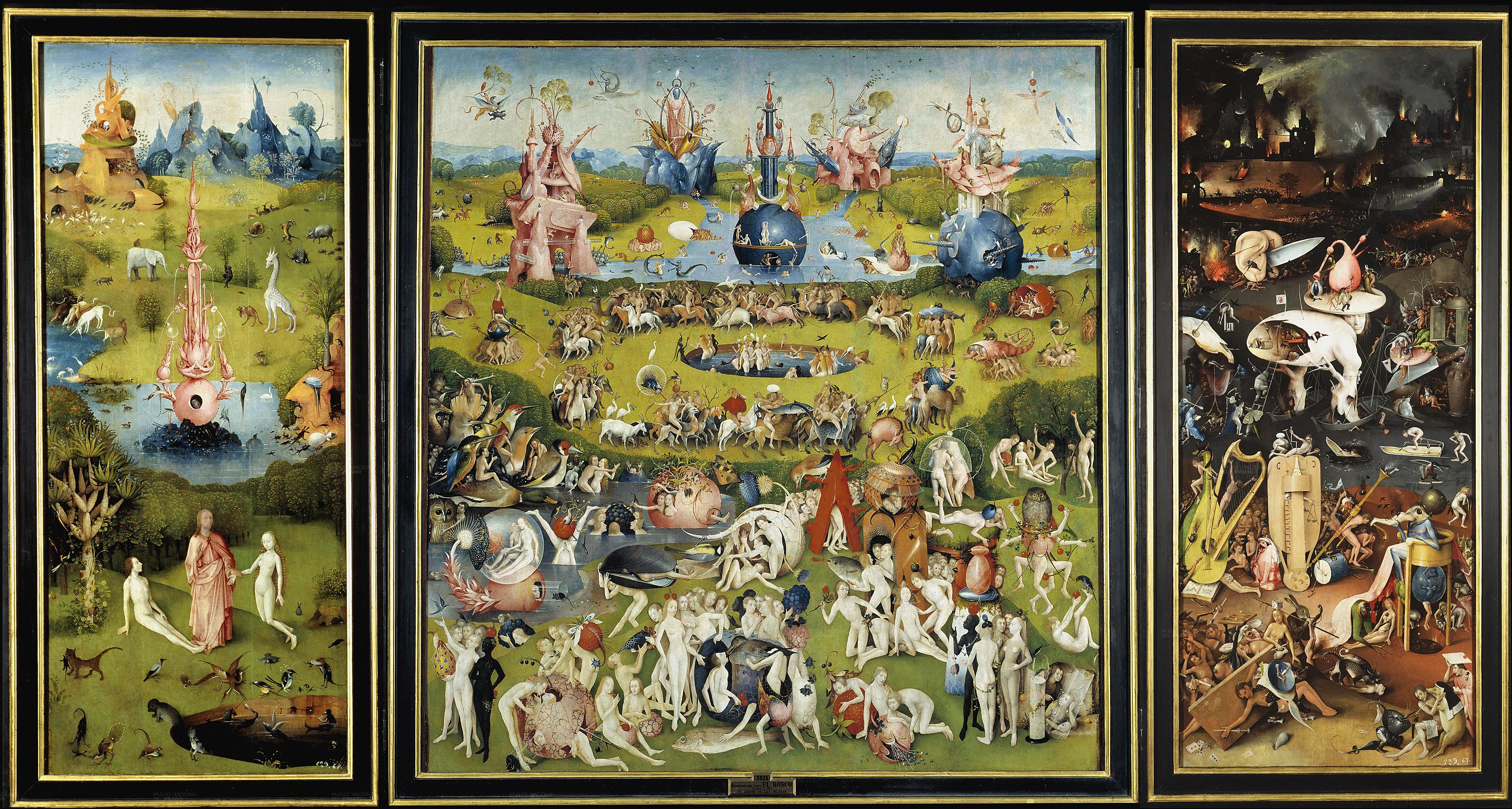
Hieronymus Bosch's painting "The Garden of Earthly Delights" - is a masterpiece and truly the work of a mad genius. Strange folks emerge from eggs, defecate flutes and seemingly contort in sinful delight across the three panels.


Well what the heck does that have to do with Infographics?!
One small figure has music written across their butt - truly one of the most unique data visualizations ever, but nevertheless it is an infographic!

But no that's not even the punch line - folks have actually arranged and recorded this composition - Hieronymus would have been proud to hear his butt piece performed!

Hieronymus Bosch Butt Music
https://www.youtube.com/watch?v=OnrICy3Bc2U

Chorale Version
http://www.discovery-zone.com/hidden-song-hell-secret-message-left-hieronymus-bosch/


Thursday, November 6, 2014

Music-Related Infographics

Music infographics


Infographic >


How the Internet has Rocked the Music Industry

Infographic >


Website that hosts a tremendous amount of data, charts
and infographics on the Music Industry

Statista >


Wednesday, January 1, 2014

Composer/Musician Timelines

Timelines
Timelines are a great way to understand the chronological sequence of events, often inferring "cause and effect" that might not be as apparent if the events are listed out of sequence.

Have you ever wondered about...
  • The sequence of compositions by a favorite composer and the events that led to their inspiration?  or... 
  • Have you been curious to know the chronological history of a favorite pop group?
Composer/Musician Histories
From the Rolling Stones to Beethoven, use the Search Field - there is a lot of good stuff to be found.

  Try toggling to Text View for a different layout.


Pop

Classical

I am partial to the Russians and Early 20th Century Composers :-)

Also (although a little overwhelming...)