Showing posts with label Infographic. Show all posts

Wednesday, January 5, 2022

What's the Golden Rule and the Green Rule?

 What's the Golden Rule?

The Golden Rule is the principle of treating others as one wants to be treated. It is a maxim that is found in most religions and cultures

The Golden Rule is the principle of treating others as one wants to be treated. It is a maxim that is found in most religions and cultures

The idea dates at least to the early Confucian times (551–479 BCE), appearing prominently in Buddhism, Christianity, Hinduism, Islam, Judaism, Taoism, Zoroastrianism, and "the rest of the world's major religions".


What's the Green Rule?

The Green Rule is derived from the classic Golden Rule found in major faith traditions, paraphrasing it by saying: "Do unto the Earth as you would have it do unto you."

Selected from many of the world’s great religious texts and spiritual teachings, the Green Rules were chosen to demonstrate that each religion and spiritual philosophy has a long-standing tradition of ecological stewardship...


Religions

Animated map showing how religion spread around the world
(YouTube  / Business Insider)

Tuesday, October 2, 2018

Great Infographics from National Geographic

National Geographic has an amazing array of high-quality infographics - artistry at its finest! Here'e a sampling of just a few - highly recommended...

Amazonia: Vital and Fragile
https://www.nationalgeographic.org/hires/amazonia/


Talking Trees, illustration for National Geographic
Beau and Alan Daniels
https://beaudaniels.com/talking-trees-a-project-for-national-geographic

In Harm's Way
https://www.nationalgeographic.org/photo/tornadographic/


Friday, October 21, 2016

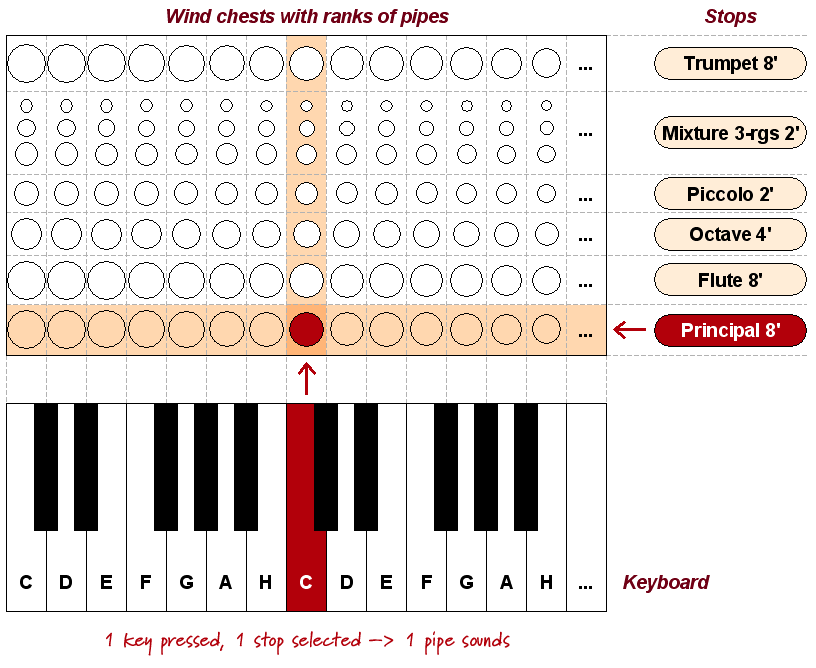
Music Mechanics Series - Tracker Organ

The organ is a fascinating mechanical contraption. Along with the clock, it was considered one of the most complex human-made mechanical creations before the Industrial Revolution. The instrument traces its history as far back as at least the 3rd Century B.C. and uses wind moving through pipes to produce sounds.

Since the 16th century, pipe organs have used various materials for pipes, which can vary widely in timbre and volume. The pipes are divided into ranks and controlled by the use of hand stops and combination pistons.

The Mechanics
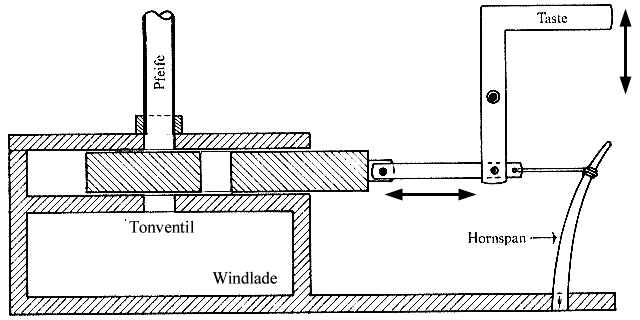
Below are an assortment of diagrams (one is even animated), all created to help illustrate the mechanics of how an organ works...


Tracker Organ

A Tracker organ uses tracker action -  a term to indicate a mechanical linkage between keys or pedals pressed by the organist and the valve that allows air to flow into pipe(s) of the corresponding note. This is in contrast to (1) direct electric action which connect the key to the valve through an electrical link or (2) electro-pneumatic action  which connect the key to an electrically assisted pneumatic system respectively, or (3) tubular-pneumatic action which utilizes a change of pressure within lead tubing which connects the key to the valve pneumatic.


Did You Know?

  • The loudest organ stop in the world is the Grand Ophicleide located in the Right Pedal division of the Boardwalk Hall Auditorium Organ (see link below). It is described as having "a pure trumpet note of ear-splitting volume, more than six times the volume of the loudest locomotive whistle." The Grand Ophicleide produces up to 130 decibels at a distance of 1 meter. A former organ curator warned the stagehands when the Grand Ophicleide was going to be used, because of the volume.
  • The air needed for the pipes to speak (usually called the "wind" by organ builders) used to be produced by people treading on or pumping up down on a lever to force wind into huge bellows on a side chamber of the organ. Today a blower worked by a huge electric motor has taken over this job, but the principle remains the same. Today a blower worked by a huge electric motor has taken over this job, but the principle remains the same.


Friday, July 8, 2016

Music Mechanics Series - Mellotron

Mellotron 

The Mellotron was originally developed and built in Birmingham, England, in 1963. The original models were designed to be used in the home, and contained a variety of sounds, including automatic accompaniments! Adopted by the Moody Blues, Genesis and King Crimson, it became a notable instrument in progressive rock. Production of the Mellotron ceased in 1986.
A diagram illustrating the internal operations of a Mellotron

How it Worked

Pressing a key (1), caused two screws (2) to connect a pressure pad (3) with the tape head (5), and the pinch wheel (4) with the continuously rotating capstan (6). Tape was pulled by the capstan at a gradual speed controlled by a tension spring (8–10) and stored temporarily in a storage bin (7) until the key was released.

Interesting Facts:

  • Noted cellist Reginald Kirby refused to downtune his cello to cover the lower range of the Mellotron, and so the bottom notes are actually performed on a double bass.
  • Pressing a key harder allows the head to come into contact under greater pressure, so to an extent,  the Mellotron responds to aftertouch.
  • Among the early Mellotron owners were Princess Margaret, Peter Sellers, King Hussein of Jordan and Scientology founder L. Ron Hubbard!
  • The Skellotron (2005) was a Mellotron in a transparent glass case. Only one was made!

Article > 


Sunday, November 16, 2014

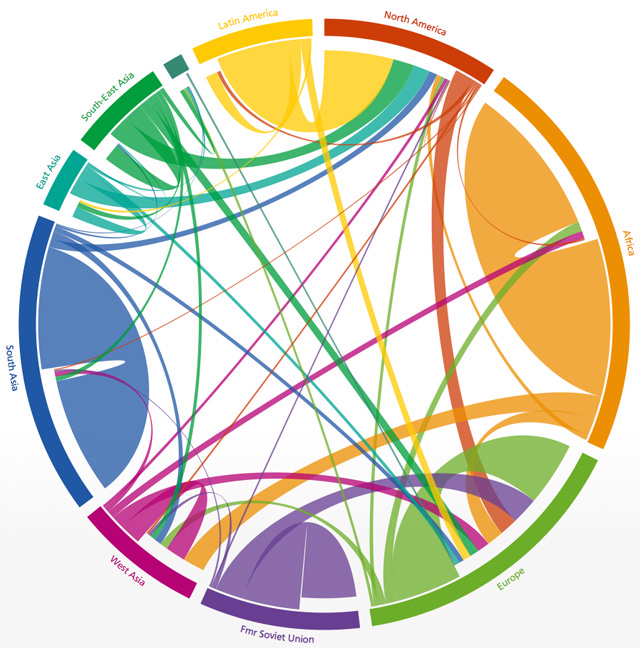
Visualizing Global Migration

Both Vintage and "Cutting Edge" Maps of Global Migration
 Global Migration circa 1858

Article >


The Global Flow of People

Five-year periods, 1990 to 2010

Wednesday, January 8, 2014

Life Expectancies Infographic


Charting the Life Expectancies of the World's Countries


(with link to magnifiable infographic)

Based on data from CIA's World Factbook and the Encyclopedia Britannica. 
A fascinating study and stunning visual summation.

Thursday, May 30, 2013

Internet Trends (Quick Chart Summary)

America's Media Attention in One Graph

Facebook in Decline

Other Charted Trends...
  • Today the Internet Is Photos
  • Apple and Samsung Ate the World and IoS and Android are burying WinTel

The 11 Most Fascinating Charts of Internet Trends

Thursday, April 18, 2013

The Shape of Song in Images

Chopin, Mazurka in F# Minor

The image illustrates the complex, nested structure of the piece.
Diagrams in The Shape of Song display musical form as a sequence of translucent arches. Each arch connects two repeated, identical passages of a composition. By using repeated passages as signposts, the diagram illustrates the deep structure of the composition.

This is cool!
Check out the interactive (wait till the java app loads)
Bach, Ravel, Miles Zavis, Isaac Hayes, Led Zeppelin, even DIY

Wednesday, April 17, 2013

Thursday, April 11, 2013

Wednesday, April 10, 2013

Wednesday, April 3, 2013

The Great Pacific Garbage Patch

The Great Pacific Garbage Patch

Somewhere in the Pacific Ccean is a floating mass trapped by currents. Consisting mainly of plastic, it is almost three times the size of Spain and Portugal combined...


Convection Currents and The Convergence Zone

(The Pacific Gyre)


This article has some wonderful interactive animations


Sunday, March 17, 2013

The Energy Curve of History

Looking at peak-oil in perspective: Ultimately, the energy-intensive industrial age we live in may be little more than a blip in the course of human history.


Monday, March 11, 2013

Drinking Water (for some)

The U.N. predicts that by 2025,
 two thirds of the world's population will suffer water shortages. 

Article >

World Water Crisis: 
1 out of 6 people lack safe drinking water


Sunday, February 24, 2013

If the World were 100 People...

An interesting challenge: If we could reduce the world's population to a village of precisely 100 people, with all existing human ratios remaining the same, how could you present the demographics if the most engaging way?


Brilliant work by Tony Ng

Click on each image for an enlargement

Stats

  • The village would have 61 Asians, 13 Africans, 12 Europeans, 9 Latin Americans, and 5 from the USA and Canada
  • 50 would be male, 50 would be female
  • 75 would be non-white; 25 white
  • 67 would be non-Christian; 33 would be Christian
  • 80 would live in substandard housing
  • 16 would be unable to read or write
  • 50 would be malnourished and 1 dying of starvation
  • 33 would be without access to a safe water supply
  • 39 would lack access to improved sanitation
  • 24 would not have any electricity (And of the 76 that do 
  • have electricity, most would only use it for light at night.)
  • 8 people would have access to the Internet
  • 1 would have a college education
  • 1 would have HIV
  • 2 would be near birth; 1 near death
  • 5 would control 32% of the entire world's wealth; all 5 would be US citizens
  • 48 would live on less than US$ 2 a day
  • 20 would live on less than US$ 1 a day

Others

If the World were 100 People (floda31)
If the World were 100 People (Ferlazzo)
If the World were 100 People (DocStac)

Tuesday, February 19, 2013

Odd Instruments Used in Popular Music

Strange Sounds... Odd Instruments Used in Popular Music
This is a wonderfully done pictorial series on unusual musical instruments. Clear illustrations and explanations pointing to various spots on each instruments bring the entire project to life!

Whamola, Drumitar, Hurdy-Gurdy, Thermin. Mellotron and more